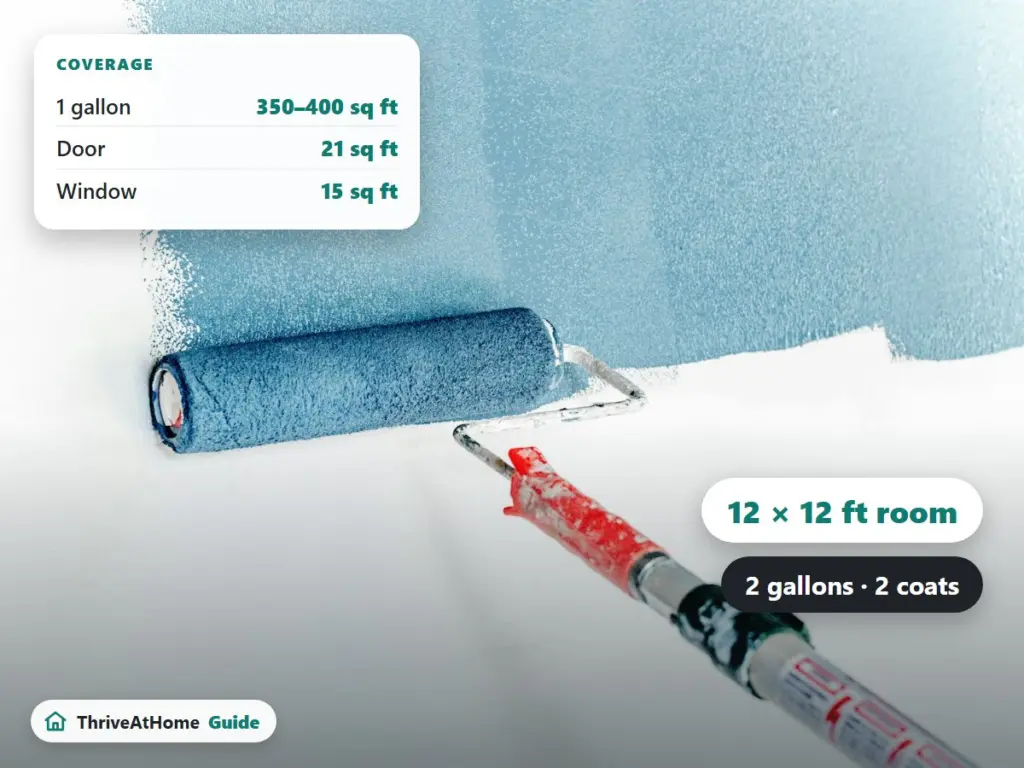
Type in your room’s length, width and wall height, plus the number of doors and windows, and the calculator below tells you how many gallons of paint to buy, already rounded to gallons and quarts. Tick the boxes to add ceiling paint or primer. Most average bedrooms land at about 2 gallons for two coats, but a tall ceiling or a dark color change can push that up quickly.
Paint Calculator
For one room. Results update as you type. Use decimals for partial feet (11 ft 6 in = 11.5).
–
Assumes a door is 21 sq ft (3 × 7 ft) and a window is 15 sq ft (3 × 5 ft). Primer is figured at 300 sq ft per gallon. If you would need 3 quarts, we suggest one more gallon instead: it usually costs about the same.
The short answer by room size
These figures assume 8-foot walls, one door, two windows, two coats and paint that covers 350 square feet per gallon.
| Room size | Paintable wall area | Paint needed | What to buy |
|---|---|---|---|
| 10 × 10 ft | 269 sq ft | 1.54 gal | 2 gallons |
| 12 × 12 ft | 333 sq ft | 1.90 gal | 2 gallons |
| 12 × 14 ft | 365 sq ft | 2.09 gal | 2 gallons + 1 quart |
| 14 × 16 ft | 429 sq ft | 2.45 gal | 2 gallons + 2 quarts |
| 16 × 20 ft | 525 sq ft | 3.00 gal | 3 gallons |
How the calculator gets its number
- Wall area: the room’s perimeter times the wall height. A 12 × 12 ft room has a 48-foot perimeter, so 48 × 8 = 384 sq ft.
- Subtract openings: 21 sq ft for each standard door (3 × 7 ft) and 15 sq ft for each average window (3 × 5 ft). One door and two windows leave 333 sq ft.
- Multiply by coats: two coats means painting 666 sq ft.
- Divide by coverage: 666 ÷ 350 = 1.9 gallons.
- Round to what the store sells: 1.9 gallons is 1 gallon plus almost 4 quarts. Three or more quarts usually cost about as much as a gallon, so the calculator suggests the extra gallon instead.
What changes how far a gallon goes
Most paint cans promise 350 to 400 square feet per gallon. That number assumes a smooth, previously painted wall. Change the coverage field in the calculator if your surface is different:
| Surface | Coverage to expect | What to enter |
|---|---|---|
| Smooth, previously painted drywall | Close to the label | 350–400 |
| Light texture (orange peel, knockdown) | About 10–20% less | 300–325 |
| Heavy texture, brick or stucco | Up to about half the label rate | Check the product label |
| New, unprimed drywall | Soaks up the first coat | Prime first, then use 350 |
One coat or two?
Plan on two coats. Even good paint looks patchy after one coat, especially under side lighting. One coat is only realistic when you’re refreshing the same color on clean walls. If you’re going from a dark color to a light one, or painting over patches and new drywall, add a coat of primer first: tick the primer box and the calculator adds it at 300 square feet per gallon.
Which sheen goes where
| Sheen | Best for | Why |
|---|---|---|
| Flat / matte | Ceilings, low-traffic rooms | Hides flaws, but harder to scrub |
| Eggshell | Living rooms, bedrooms | Soft look that wipes clean |
| Satin | Hallways, kitchens, kids’ rooms | Stands up to frequent cleaning |
| Semi-gloss | Trim, doors, bathrooms | Resists moisture and scuffs |
| Gloss | Cabinets, railings | Toughest finish, but shows every flaw |
Buying tips that save a second trip
- Buy it all at once. Tinted paint can vary slightly from one batch to the next. If you need several gallons, pour them into a large bucket and mix them together (“boxing”) so the color is even on every wall.
- Trim is separate. Doors, baseboards and window frames usually get a semi-gloss in a different can. A quart often covers the trim in an average room.
- Keep a labeled leftover. Write the room and the date on the lid. A cup of the original paint makes touch-ups invisible years later.
- Paint from the top down. Ceiling first, then walls, then trim, so drips only land on surfaces you haven’t painted yet.
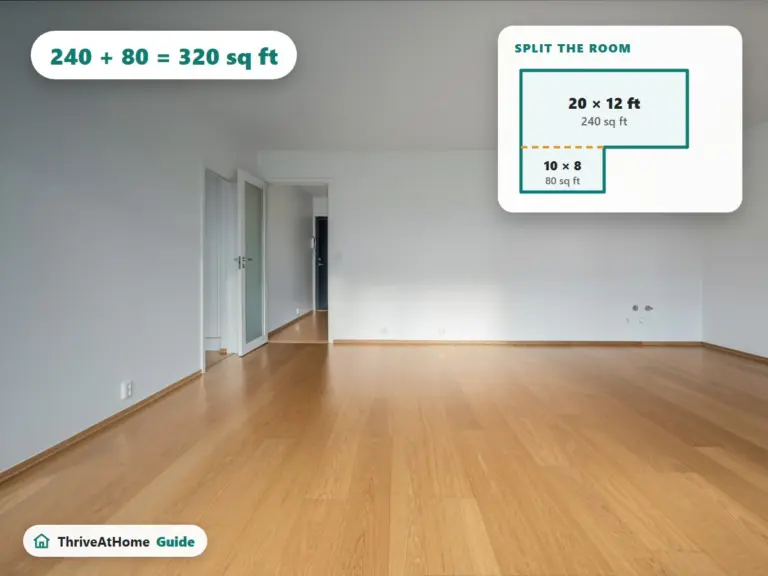
Measuring an L-shaped room or an accent wall with odd angles? Find the area first with the square footage calculator, then divide by your paint’s coverage.
Frequently asked questions
How much paint do I need for a 12 × 12 room?
About 2 gallons for two coats on 8-foot walls with one door and two windows. Add roughly 1 gallon if you’re also painting the ceiling with two coats.
How many square feet does a gallon of paint cover?
Typically 350 to 400 square feet per coat on smooth walls. Textured, porous or unprimed surfaces take more paint, so the real number can be much lower.
Should I subtract doors and windows?
Yes, for anything bigger than a small window. The calculator subtracts 21 sq ft per door and 15 sq ft per window. If you have a large patio door or a picture window, count it as two.
Is it better to buy a little extra?
A little, yes. Running out mid-wall leaves a visible line where the new can starts. The calculator already rounds up, so you’ll usually have enough left for touch-ups.