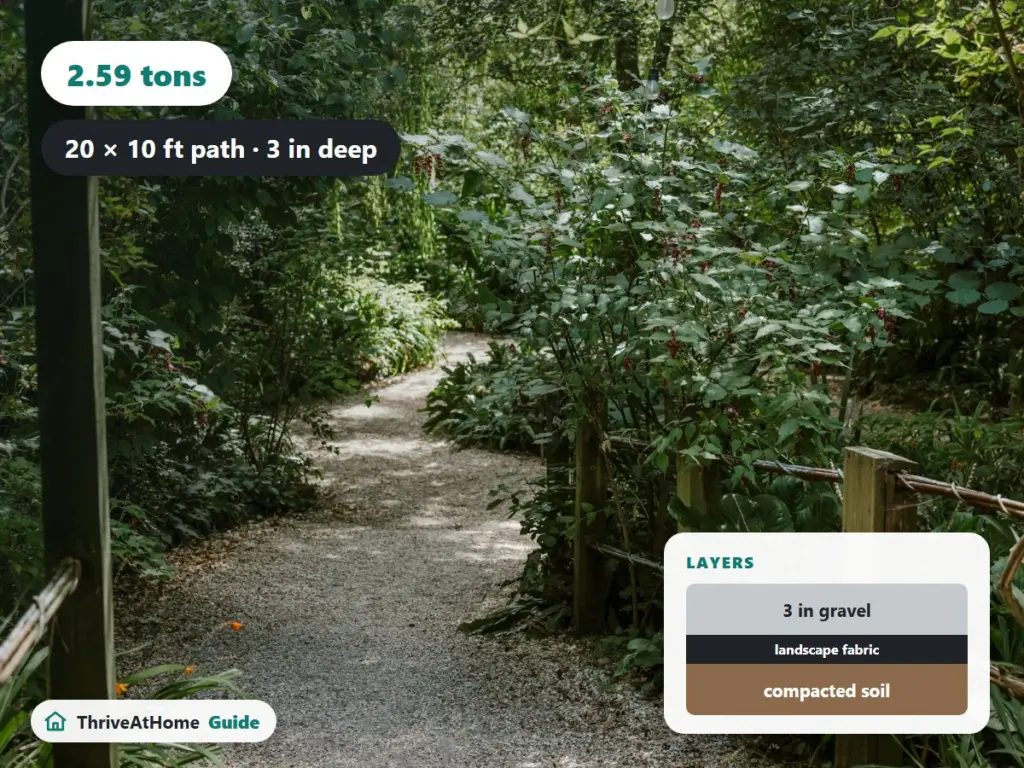
Enter the size and depth of your path, patio base or driveway, pick the type of stone, and the calculator below shows how many tons and cubic yards of gravel to order, plus the bag count for small jobs. Suppliers sell gravel by the ton or by the yard, so you’ll see both. As a quick reference, one ton of pea gravel covers roughly 77 square feet at 3 inches deep.
Gravel Calculator
Results update as you type. Use decimals for partial feet (12 ft 6 in = 12.5).
–
Densities are typical averages: moisture and stone size change them. If your supplier quotes a different weight per yard, use the custom option. Bags assume 0.5 cu ft each (a common 50 lb bag).
Tons vs. cubic yards: why you need both numbers
Your project is measured in volume (length × width × depth), but many quarries and landscape yards price gravel by weight. The bridge between the two is density: how many tons one cubic yard of that stone weighs. Most gravels fall between 1.3 and 1.5 tons per cubic yard, depending on the stone, its size and how wet it is.
20 × 10 × 0.25 = 50 cu ft
50 ÷ 27 = 1.85 yd³
1.85 × 1.4 = 2.59 t
≈ 2.85 tons
Three inches is 0.25 ft (3 ÷ 12). The 10% extra covers the way gravel settles and compacts once you walk or drive on it, plus a little spillage. For crusher run and other base materials that you compact hard with a plate compactor, some installers add 15–20%.
How deep should the gravel be?
These are typical starting points. Soft or clay soil, heavy vehicles and steep slopes all call for more depth, so ask your supplier what works in your area.
| Project | Typical depth | Usual stone |
|---|---|---|
| Decorative beds | 2–3 in | Pea gravel, river rock |
| Garden path or walkway | 2–3 in on top of a compacted base | Pea gravel, decomposed granite |
| Base under pavers or a patio | 4–6 in, compacted | Crusher run / road base |
| Base under a concrete slab | About 4 in, compacted | Crusher run or #57 stone |
| Gravel driveway | 4–6 in base plus 2–3 in top layer | Crusher run base, #57 stone on top |
| French drain | Fill the trench around the pipe | Clean, washed #57 stone |
For layered projects like driveways, run the calculator once per layer: the base and the top stone usually have different densities and are often ordered separately.
Pick the right gravel
| Type | What it is | Best for | Watch out for |
|---|---|---|---|
| Pea gravel | Small, rounded stones about 3/8 in | Paths, play areas, decorative beds | Rolls underfoot; drifts on slopes and driveways |
| #57 stone | Angular crushed stone, about 3/4–1 in | Drainage, driveway top layer, slab base | Sharp edges aren’t comfortable barefoot |
| Crusher run | Crushed stone mixed with stone dust | Compacted base for driveways, pavers and patios | Drains more slowly because the fines fill the gaps |
| River rock | Smooth, rounded stones, 1–3 in | Dry creek beds, borders, decorative areas | Hard to walk on; not a base material |
| Decomposed granite | Fine granite particles that pack firm | Paths and casual patios | Can track indoors and wash out on slopes |
Bags or bulk delivery?
A typical 50 lb bag holds about half a cubic foot, so one cubic yard equals about 54 bags. Bags make sense for a small bed or for topping up a path. Once a project needs more than about half a ton, bulk delivery from a landscape supply yard is usually far cheaper per ton, and it saves you from lifting dozens of bags.
Tips for a gravel area that lasts
- Dig out the sod and soil first. Gravel spread on top of grass sinks in, and weeds come through within a season.
- Use landscape fabric under decorative gravel. It keeps the stone from mixing into the soil. Skip it under driveway bases unless your installer recommends a heavy-duty geotextile.
- Compact in layers. Spread base material a few inches at a time and compact each layer instead of trying to compact 6 inches at once.
- Add edging. Steel, stone or plastic edging keeps pea gravel and decomposed granite from spreading into the lawn.
Pouring a slab on top of your gravel base? Size the concrete with the concrete calculator. Covering soft beds instead of paths? The mulch calculator works the same way.
Frequently asked questions
How much area does a ton of gravel cover?
For gravel at about 1.4 tons per cubic yard, one ton covers roughly 115 square feet at 2 inches, 77 square feet at 3 inches and 58 square feet at 4 inches.
How many tons are in a cubic yard of gravel?
Usually 1.3 to 1.5 tons. Denser, well-graded materials like crusher run sit at the high end; washed stone and decomposed granite sit lower. Your supplier can tell you the exact figure for their material.
How many bags of gravel are in a ton?
About 40 bags of 50 lb (2,000 lb ÷ 50 lb). By volume, a ton of pea gravel is roughly 19 cubic feet, or about 39 half-cubic-foot bags.
What’s the cheapest gravel for a driveway?
Crusher run is usually among the least expensive options, and it compacts into a firm surface, which is why it’s the standard base layer. Prices vary a lot by region, so get quotes from two or three local yards.