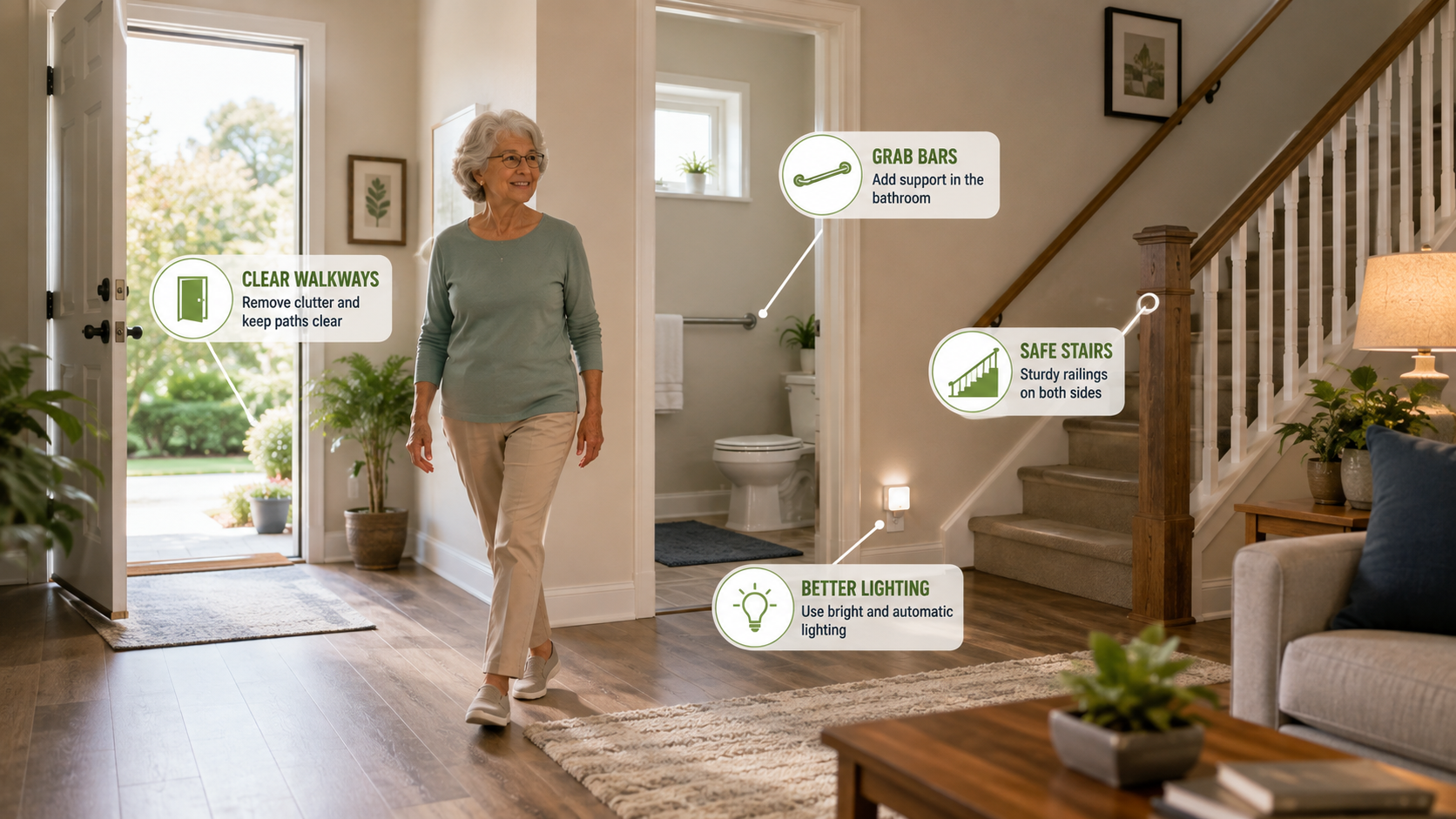
Home Safety for Seniors: A Complete Guide to Aging-in-Place Modifications
A home that felt perfectly comfortable for decades can quietly turn into an obstacle course as we age — a step here, a slippery tub there, a doorknob that stiff hands can no longer turn. The good news is that a few thoughtful changes make an enormous difference. This guide covers home safety for seniors from the ground up: the modifications that keep a home safe, accessible, and comfortable for aging in place, organized by priority and cost.
Quick answer
The most important home safety modifications for seniors are grab bars in the bathroom, bright and automatic lighting, removing trip hazards, and sturdy railings on stairs. From there, higher-value upgrades include a walk-in or curbless shower, a comfort-height toilet, lever door handles, and a step-free entrance. Start with the essentials, then add changes as needs grow.
Why home safety matters as we age
Small changes in balance, strength, vision, and grip mean everyday tasks carry more risk than they used to. The most serious consequence is a fall — the leading cause of injury for adults 65 and older — but an unsafe home also chips away at confidence and independence. Most homes were built for young, able-bodied adults rather than for aging in place, a gap highlighted by AARP’s free HomeFit Guide. Making the home safer is the single most cost-effective step in any aging-in-place plan, and it pairs directly with our guide on how to prevent falls at home.
This guide focuses on modifications — the changes you make to the home itself. For the free, five-minute fixes (clearing clutter, securing rugs, adding nightlights), start with the fall-prevention checklist above; then use this guide to plan the more permanent upgrades.
Home safety modifications by priority
You do not need to do everything at once. This tiered approach helps you spend where it matters most, first.
Room-by-room and cost: key modifications
Here are the modifications that deliver the most safety, what each one helps with, and a rough one-time cost. Prices vary widely by product, home, and whether you install it yourself or hire a professional.
| Modification | What it helps with | Approx. one-time cost (USD) |
|---|---|---|
| Grab bars (bathroom) | Support at toilet, shower, and tub | $15–40 each + install |
| Comfort-height toilet / raised seat | Easier, safer sitting and standing | $25–400 |
| Walk-in or curbless shower | Eliminates the tub step-over | $2,500–10,000+ |
| Lever door & faucet handles | Easy use for weak or arthritic hands | $10–30 each |
| Brighter + motion-sensor lighting | Visibility, especially at night | $10–30 per fixture |
| Stair railings (both sides) | Safe use of stairs | $100–300 |
| Stairlift | Access between floors when stairs are unsafe | $2,000–5,000+ |
| Entry ramp / step-free entrance | Getting in and out safely | $1,000–3,000+ |
For deep dives into the two highest-risk areas, see bathroom modifications for aging in place and home lighting for seniors. To make the kitchen safer and easier to use, read our guide to an accessible kitchen.
Home safety for seniors, room by room
Every room has one or two changes that matter most. Here is where to focus in each space.
- Bathroom — grab bars, non-slip surfaces, and a walk-in shower. Full guide: bathroom modifications.
- Kitchen — store everyday items within easy reach, add task lighting, and fit lever faucets. See our accessible kitchen guide.
- Stairs & hallways — railings on both sides, high-contrast edge marking, and bright, switchable lighting.
- Bedroom — a bed at the right height, a lamp within reach, and a clear, lit path to the bathroom.
- Living room — a firm, supportive chair, wide pathways, and no loose rugs or cords.
- Entryways — step-free access where possible, lever handles, and good lighting at the door.
Don’t overlook the outdoors: entrance and exterior safety
Safety does not stop at the front door. Steps, paths, and poor outdoor lighting cause many injuries, and they are easy to overlook.
- Add sturdy handrails to outdoor steps, porches, and the path to the door.
- Light walkways, the driveway, and the entrance with motion-sensor fixtures.
- Keep paths even and clear of ice, moss, and leaves, and repair cracked or uneven surfaces.
- Consider a ramp or step-free entrance for anyone using a walker or wheelchair — see our guide to mobility aids.
- Make the house number large and visible so emergency responders can find the home quickly.
Fire, carbon monoxide, and emergency safety
Home safety is more than preventing falls. Older adults face higher risk in a fire: at age 65, people are more than twice as likely to die in a home fire, and adults 65 and older account for about 45% of home-fire deaths, according to the National Fire Protection Association (NFPA). A few steps sharply reduce the danger.
- Install interconnected smoke and carbon monoxide alarms on every level, and test them monthly. Choose models with 10-year sealed batteries, or a bed-shaker or strobe alert for anyone with hearing loss.
- Practice a simple escape plan with two ways out of each room, reachable without stairs where possible.
- Cooking is the top cause of home fires — never leave the stove unattended, and keep towels and packaging away from burners.
- Store medications safely and keep an up-to-date list handy for emergencies.
- Keep a phone or a medical alert system within reach so help is one button away.
Think universal design, not “for the elderly”
The best modifications do not make a home look like a hospital — they simply make it work better for everyone. This idea is called universal design: features that are comfortable for all ages and abilities. A curbless shower, lever handles, good lighting, and a step-free entrance are just as convenient for a young parent carrying groceries as for an older adult. Choosing designs that blend in keeps a home feeling like home, which makes changes far easier to accept.
Where to start and when to call a professional
Begin with a walkthrough. Our home safety assessment guide gives you a room-by-room checklist to spot the biggest risks. Tackle the essential tier first, then plan high-value upgrades as the budget allows.
- An occupational therapist (OT) can assess the home and recommend changes matched to a specific person’s abilities — often the most valuable first call.
- A Certified Aging-in-Place Specialist (CAPS) is a contractor trained in these modifications, useful for bathrooms, ramps, and structural work.
- Anything structural or load-bearing — grab bars anchored to studs, stairlifts, widened doorways — should be installed by a qualified professional so it holds when it matters.
Budget tip. You do not have to pay for everything out of pocket. Medicaid waivers, VA grants, and local Area Agency on Aging programs may help cover modifications — see the funding options in our aging-in-place guide.
Key takeaways
- Start with the essentials: bathroom grab bars, good lighting, no trip hazards, and stair railings.
- Add high-value upgrades next — a walk-in shower, comfort-height toilet, and lever handles.
- Choose universal design so the home stays welcoming, not clinical.
- Get an occupational therapist’s assessment and use a professional for structural work.
- Look into Medicaid, VA, and community programs to help with costs.
Frequently asked questions
What are the most important home safety modifications for seniors?
The highest-impact changes are grab bars in the bathroom, bright and automatic lighting, removing trip hazards like loose rugs, and sturdy railings on both sides of stairs. These address the most common causes of falls and are relatively low cost.
How much does it cost to make a home safe for aging in place?
It ranges from very little to several thousand dollars. Essential items like grab bars, lighting, and railings can total a few hundred dollars. Larger projects — a walk-in shower, stairlift, or ramp — run from about $1,000 to $10,000 or more. Most are one-time costs, unlike the monthly price of a care facility.
Does Medicare pay for home modifications?
Generally no. Medicare does not cover most home remodeling, though it may pay for certain durable medical equipment, like a walker, when prescribed. Medicaid waivers and VA grants are more likely to help with structural modifications for those who qualify.
Should I hire a professional or do it myself?
Simple items like nightlights and lever handles are easy DIY. But anything that must bear weight or is structural — grab bars anchored to studs, stairlifts, widened doorways — should be installed by a qualified professional. An occupational therapist can also help you prioritize the right changes.
What is universal design?
Universal design means creating spaces and features that work for people of all ages and abilities — such as curbless showers, lever handles, and step-free entrances. It makes a home safer for older adults while still looking and feeling like a normal, welcoming home.
Besides falls, what home safety risks should seniors consider?
Fire and carbon monoxide are major ones — adults 65 and older make up about 45% of home-fire deaths (NFPA). Working smoke and CO alarms, a practiced escape plan, safe cooking habits, and a way to call for help all matter. Outdoor steps, paths, and lighting deserve attention too.
Written by Jimena Vargas. Jimena researches and tests home-safety and mobility products, translating guidance from trusted health and aging authorities into plain, practical advice. She is not a medical professional.
Sources: National Institute on Aging — Preventing Falls at Home; CDC — About Older Adult Fall Prevention; AARP HomeFit Guide; NFPA — Fire Safety for Older Adults. Cost ranges are general U.S. estimates and vary widely.
This article is for general educational purposes only and is not medical, financial, or professional advice. Always consult a qualified professional about your specific situation. See our full Medical Disclaimer.