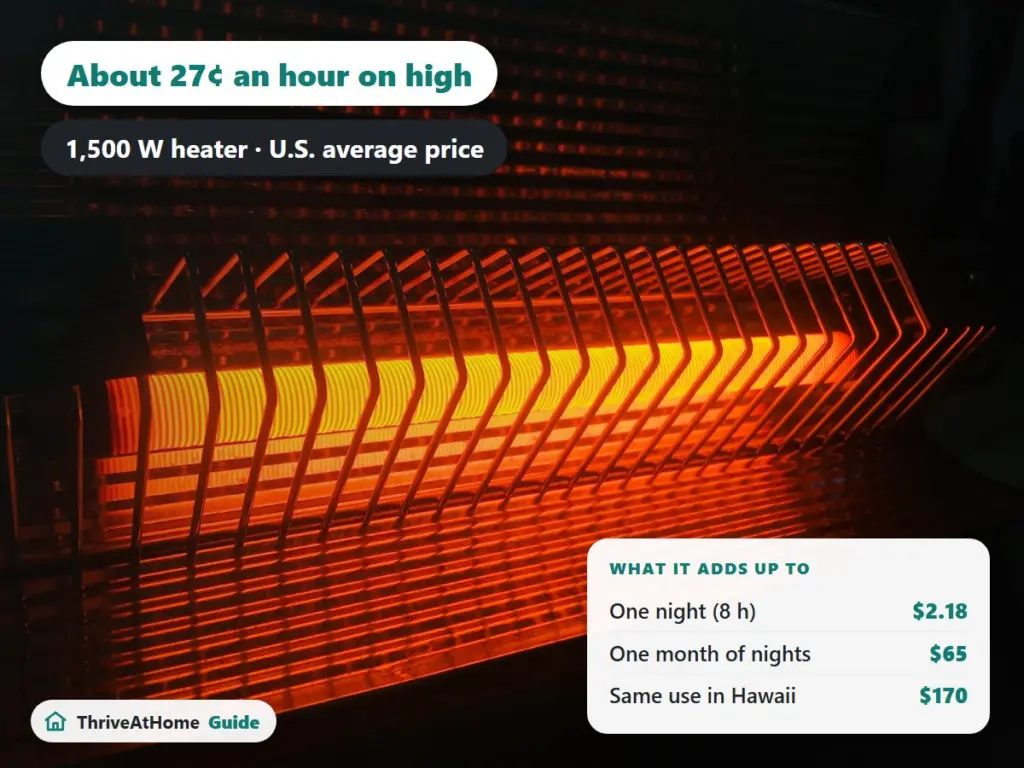
Here’s a fun way to think about that little heater under your desk: on high, it pulls about 1,500 watts, the same as a typical hair dryer. Now imagine leaving a hair dryer running for eight hours. At the average U.S. home electricity price, that’s roughly 27 cents an hour, about $2.18 a night, and $65 a month if it runs nonstop. In practice it’s usually less, because the thermostat clicks it on and off. Plug your own numbers into the calculator and you’ll know exactly what that cozy corner is costing you.
Space Heater Cost Calculator
Pick your heater setting, how long it runs and your state. Results update as you type.
–
The math fits on a sticky note
Every electric space heater, from a $25 cube to a fancy oil-filled radiator, is billed the same way: by the kilowatt-hour. You only need three numbers: the heater’s wattage (it’s on the label or in the manual), how many hours it runs and your electricity rate (it’s on your bill as “¢ per kWh”).
Example: a 1,500 W heater on high for 8 hours uses 1.5 × 8 = 12 kWh. At the national average of 18.16¢ per kWh, that’s 12 × $0.1816 = $2.18.
Your state changes the answer a lot
The same heater, the same eight hours a night, can cost almost four times more in Hawaii than in Nevada. Here’s what one month costs at each state’s average home electricity price, running 1,500 W nonstop for 8 hours a day:
Average residential prices for August 2026 from the U.S. Energy Information Administration. Your utility’s rate, and winter pricing, can differ, so the number on your bill always wins. Pick your state in the calculator above to see your own estimate.
Four things people believe about space heaters
When a space heater saves money (and when it quietly doesn’t)
A space heater is a spotlight, not a floodlight. It makes sense when you spend the evening in one room, like a home office or a bedroom, and can drop the thermostat for the rest of the house by a few degrees. It stops making sense the moment it becomes a second heating system running on top of the first.
There’s also a limit to how efficient a plug-in heater can be. Every watt becomes heat, which sounds perfect, but a heat pump does better because it moves heat from outside instead of making it. ENERGY STAR says certified mini split heat pumps can use up to 60% less energy than standard electric radiators. If you’re running heaters every winter in the same rooms, it’s worth pricing out a mini split.
Ways to stay warm and pay less
- Close the door. A heater fighting an open hallway runs nonstop. A closed room lets the thermostat do its job.
- Use the thermostat, not the high setting. Set a comfortable temperature and let the heater cycle. That’s the “about half” option in the calculator, and it roughly halves the bill.
- Warm the person, not the room. An electric blanket or heated throw uses a fraction of a space heater’s wattage.
- Stop the drafts. A rolled towel at the bottom of a door or a strip of weatherstripping on a leaky window is the cheapest heat you’ll ever buy.
- Size it right. A 1,500 W heater is plenty for a typical bedroom. Our BTU calculator (heating tab) shows what a bigger or colder room needs.
Portable heaters are linked to about 1,600 home fires and 70 deaths a year, according to the Consumer Product Safety Commission. Its rules are simple:
- Plug it directly into a wall outlet, never into an extension cord or power strip.
- Keep it at least 3 feet from curtains, bedding, furniture and anything else that can burn.
- Turn it off when you go to sleep.
And a habit worth adding: switch it off whenever you leave the room.
So, is it worth plugging in?
For one room and a few hours a night, usually yes. At the national average price, a full night on high runs about $2.18 if the heater never cycles off, and closer to $1.09 when its thermostat keeps it heating about half the time. Where it stops making sense is the “second furnace” scenario: two or three heaters running for most of the day while the central heat is still set to 70. If that sounds like your house, a heat pump or a few weekends of draft-sealing will do more for your bill than any heater setting.