Stairs are where a small misstep can turn serious. A trip on flat floor might mean a bruise; the same trip at the top of a staircase can mean a broken wrist or hip. The good news is that stairs are also one of the most fixable parts of a home. This guide covers stair safety for seniors — why stairs are risky, what a safe staircase looks like, how to use stairs more safely, and when it is time to consider alternatives.
Why stairs are so risky for older adults
Stairs combine several fall risks in one place. Going down asks the most of balance and leg strength, and each step requires judging depth accurately — something aging eyes, and especially bifocal or progressive lenses, make harder. Many falls happen on the top or bottom step, where people miscount or think they have reached the floor. Add a dim landing, socks on smooth treads, or an armful of laundry blocking the view, and the risk climbs quickly. Research also shows that older adults who fall on stairs are more likely to break a bone than younger people.
Anatomy of a safe staircase
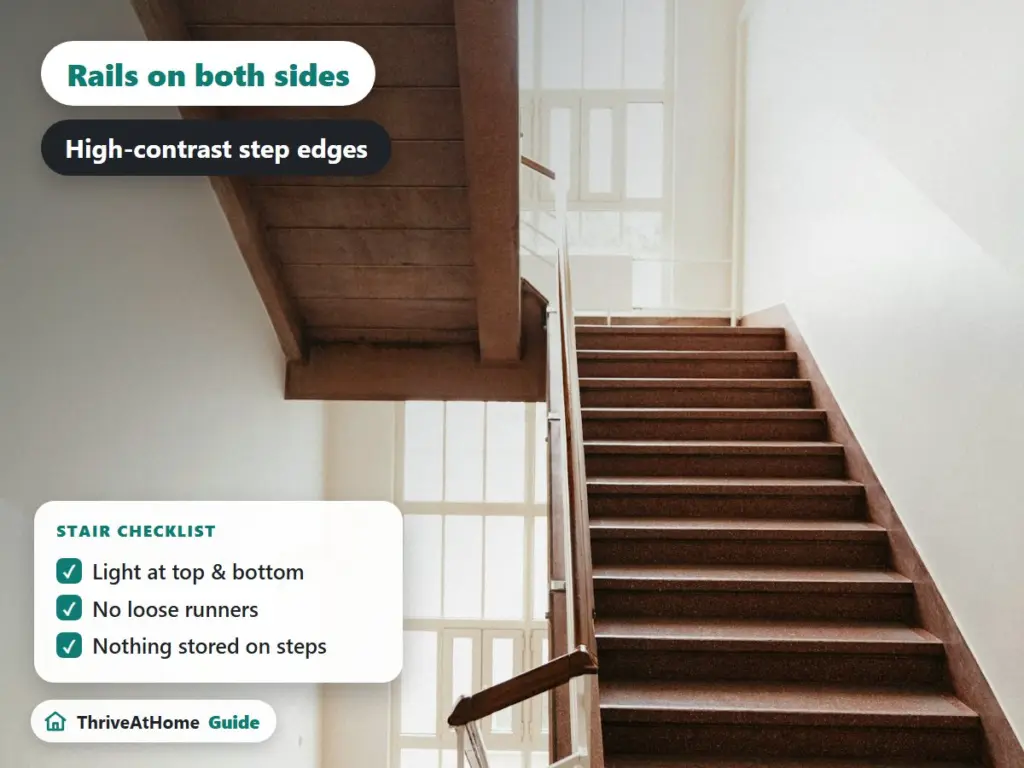
Walk your stairs from top to bottom and check each feature below. Every one of them closes a common fall scenario.
Handrail height: residential building codes generally place the top of the handrail 34 to 38 inches above the stair nosing. Just as important, the rail should run the full length of the stairs, be round or easy to wrap a hand around, and be anchored firmly enough to hold your full weight. For lighting specifics, see our guide to home lighting for seniors.
How to use stairs more safely
- Turn the light on first — every time, even for “just a second.”
- Keep at least one hand on the rail, ideally both. A rail you are not holding cannot catch you.
- Never carry anything that blocks your view of your feet. Use a bag with a shoulder strap, or make two trips.
- Wear supportive, non-slip shoes — not socks, loose slippers, or bare feet.
- Take it slowly, one step at a time, and pause on the landing if you feel tired or dizzy.
- Using a cane? Remember “up with the good, down with the bad”: lead with the stronger leg going up and the weaker leg (with the cane) going down.
Stair safety fixes by budget
| Fix | Why it helps | Approx. cost (USD) |
|---|---|---|
| Remove or secure loose runners | Eliminates a major trip hazard | $0–100 |
| High-contrast edge tape | Makes each step edge visible | $10–30 |
| Non-slip stair treads | Better grip on smooth wood or tile | $30–80 |
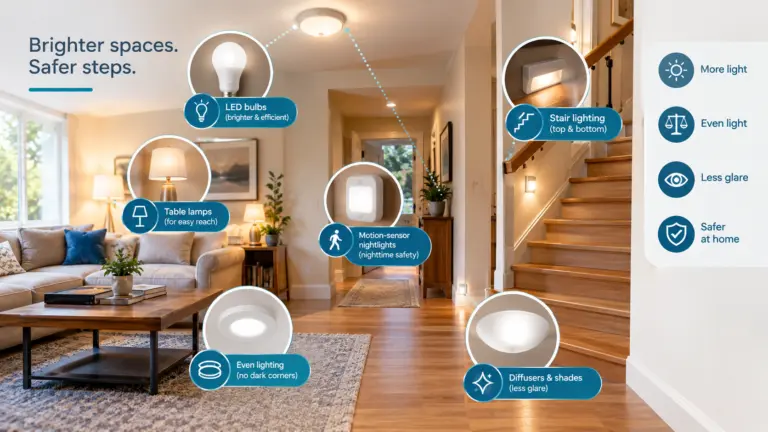
| Brighter lights + switches at both ends | No walking into a dark stairway | $20–200 |
| Second handrail (installed) | Support on both sides, both directions | $100–300 |
| Stairlift | Access between floors when stairs are unsafe | $2,000–5,000+ |
Don’t forget outdoor steps
Porch and entry steps face rain, ice, wet leaves, and darkness. Give them the same treatment: a sturdy rail, motion-sensor lighting, a non-slip surface, and prompt clearing in bad weather. If steps are becoming a real barrier, a ramp or step-free entrance may be worth planning — see home safety modifications.
When stairs become too risky
Watch for these signs that stairs need a bigger solution: a fall or near-fall on the stairs, needing to stop partway up, gripping the wall as well as the rail, or avoiding the upstairs altogether out of fear. At that point, the main options are:
- Strength and balance therapy — a physical therapist can often make stairs safer again.
- Single-floor living — moving the bedroom and a bathroom to the main floor.
- A stairlift — a powered seat that travels along the staircase.
- The right mobility aid for getting around each floor, if anyone in the home needs one.
✅ Two-minute stair safety check
Press Ctrl + P (or Cmd + P) to print this check.
Frequently asked questions
What is the safest way for a senior to go down stairs?
Turn the light on, hold the handrail (both rails if possible), keep your hands free of anything that blocks your view, and go one step at a time. With a cane, step down with the weaker leg and the cane together, then bring the stronger leg down.
How high should a stair handrail be?
Residential building codes generally set the top of the handrail at 34 to 38 inches above the front edge of each step. Check your local code, and make sure the rail is continuous, easy to grip, and securely anchored.
Do older adults need handrails on both sides of the stairs?
It is strongly recommended. A rail on each side gives support with either hand, both going up and coming down — which matters when one side of the body is weaker.
When should someone consider a stairlift?
Consider one when stairs are causing falls or near-falls, are no longer safe even with rails and good lighting, or are keeping someone from using part of their home. An occupational therapist can help decide whether a stairlift, therapy, or single-floor living is the best fit.
The short version: light every stairway, rail both sides, make each edge visible, keep steps clear, and use the rail every time. Stairs are one part of a safer home — continue with our guide to home safety for seniors.
Written by the ThriveAtHomeGuide editorial team. We research home projects using manufacturer specifications, government agencies and university extension guides, and turn that research into plain, practical guides. We are not licensed contractors or medical professionals.
Sources: Stair-related injuries treated in U.S. emergency departments (Am J Emerg Med); Rising stair-related fractures among older adults (NIH/PMC); National Institute on Aging — Preventing Falls at Home.
This article is general information about home safety and accessibility, not professional or medical advice. Check local building codes, and hire a licensed professional for electrical, plumbing or structural work. See our full Disclaimer.